
Self Cleaning Litter Box Buying Guide: What to Check Before You Buy
An automatic litter box is one of the few cat purchases that costs real money and then quietly changes your week. No scoop by the back door, no bag of waste sitting in the kitchen bin, no guilty scramble ten minutes before guests arrive. It is also the purchase people most often get wrong, because the listings all show the same smiling cat and none of them tell you the three or four things that decide whether the box works in your home.
This is the short version of what to check. It is written around the box we sell, the 65L smart self cleaning litter box, but every point applies whichever one you end up buying.
What a self cleaning box actually does for you
The mechanism is simple. After your cat leaves, the box waits a few minutes, then rotates the drum so clumps fall through a sieve into a sealed bin underneath. Clean litter drops back into the tray. You are left with a flat, fresh surface and a lidded bin that holds a couple of weeks of waste.
The part people underestimate is the smell. Scooping once a day still leaves urine sitting in litter for up to twenty four hours. A box that sifts after every visit moves waste into a sealed compartment within minutes, which is why a self cleaning box in a small flat usually smells better than a manual box in a big house.
The part people overestimate is the time saving. You still empty the bin, still top up litter, still wipe the drum every few weeks. What you save is the daily five minutes and the mental load of remembering.
Safety is the first spec, not a bullet point at the bottom
This is where cheap units fail. A box under about a hundred dollars usually relies on one infrared beam across the opening. Litter dust coats the sensor within days and the beam stops seeing reliably, which is exactly the failure mode you do not want in a machine that rotates.
What to look for instead is redundancy: weight sensors in the base plus infrared detection at the entrance, so the two systems cover each other. Our box uses four weight sensors and infrared detection together, and the drum is a single sealed piece with no internal gaps, so there is nowhere for a paw or a tail to be caught even mid cycle. If a cat steps in during a rotation, the cycle stops.
Ask one question of any box you are considering: what happens if the sensor is dirty. If the answer is that the box simply carries on, walk away.
Drum size decides which cats can use it
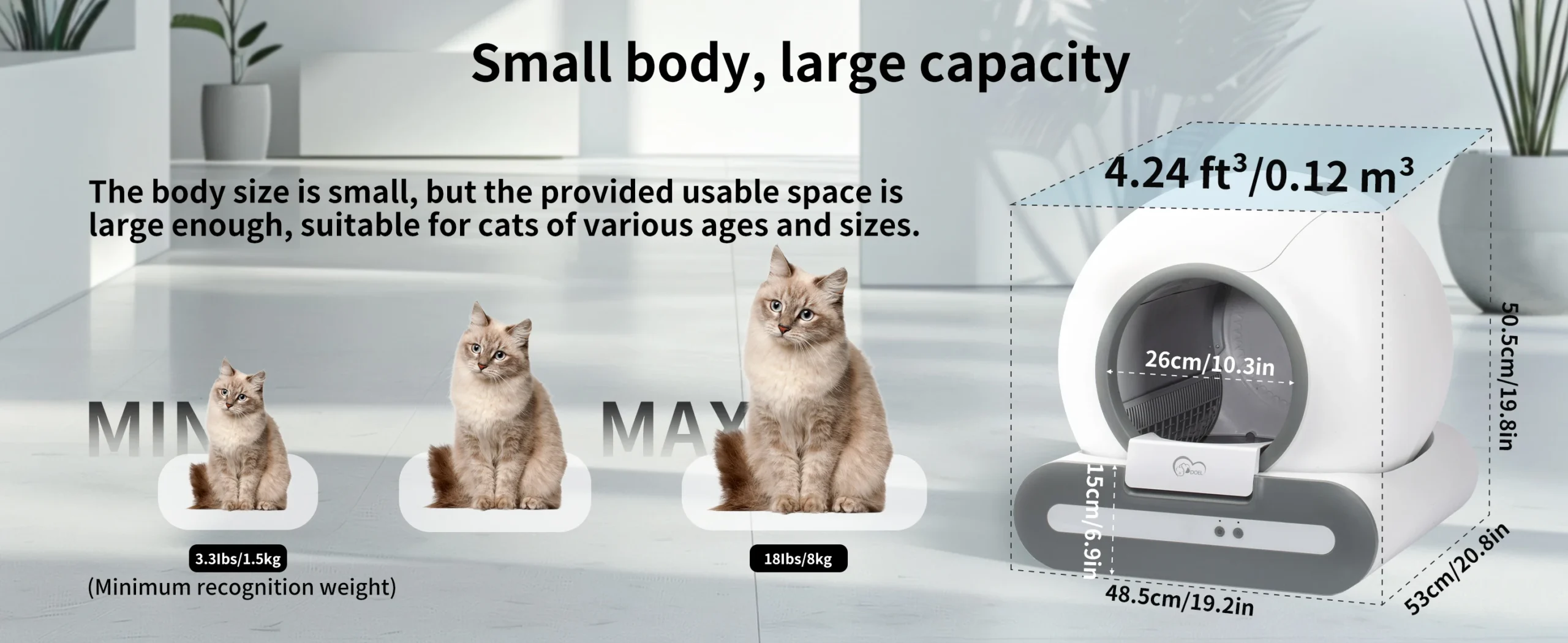
Automatic boxes have a weight range, and it is not marketing. The sensors are calibrated to a band, and the drum has to be wide enough for a cat to turn around and dig without hitting the walls. Ours is rated for cats from 3.3 to 17.6 pounds and for cats over six months old. A kitten is too light to trigger the sensors properly, which is why the age limit exists.
Volume matters for a different reason. A 65 litre drum holds enough litter that a large cat can dig a proper hole, and it takes about fifteen days of single cat use before the 9 litre waste bin needs emptying. Smaller drums look tidier in photos and then need attention twice a week.
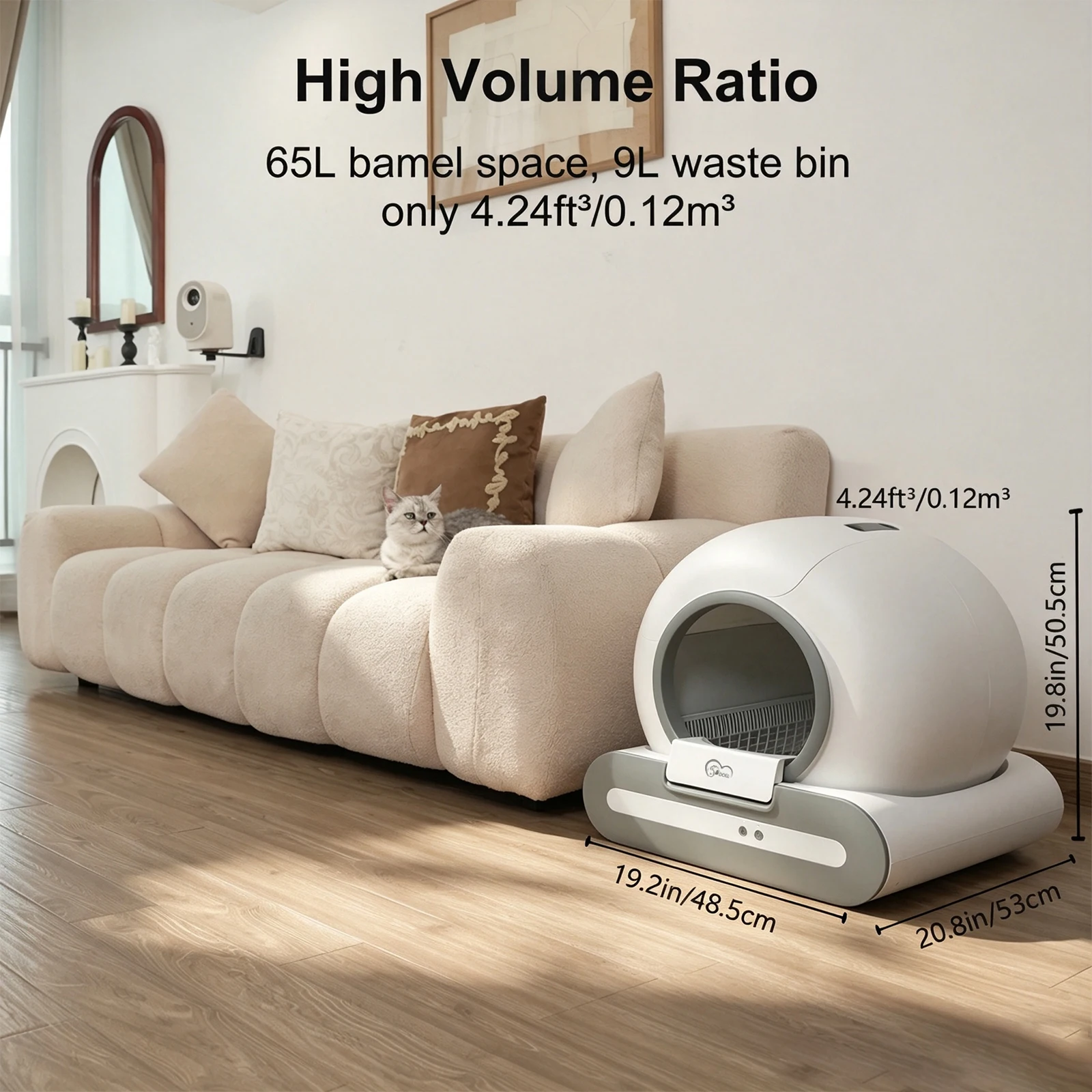
The footprint is the reassuring bit. A 65 litre drum occupies roughly 24.5 by 19.2 inches of floor, so it fits in a laundry nook or beside a washing machine without dominating the room.
Check your litter before you check anything else
More returns come from litter incompatibility than from any other cause. Sifting only works if the waste forms a clump firm enough to survive the rotation. Some well known boxes are locked to crystal litter. Others rule out paper, pellets and tofu.

Our box takes clumping litters in bentonite, tofu, mixed and mineral, with a grain size up to about 0.6 inches, and you pick the matching mode in the app so the cycle timing suits the clump strength. If your cat is settled on a litter that a box cannot handle, either budget for switching litter slowly over a few weeks, or buy a different box. Do not assume your cat will just accept the change.
The app: useful, or something you stop opening
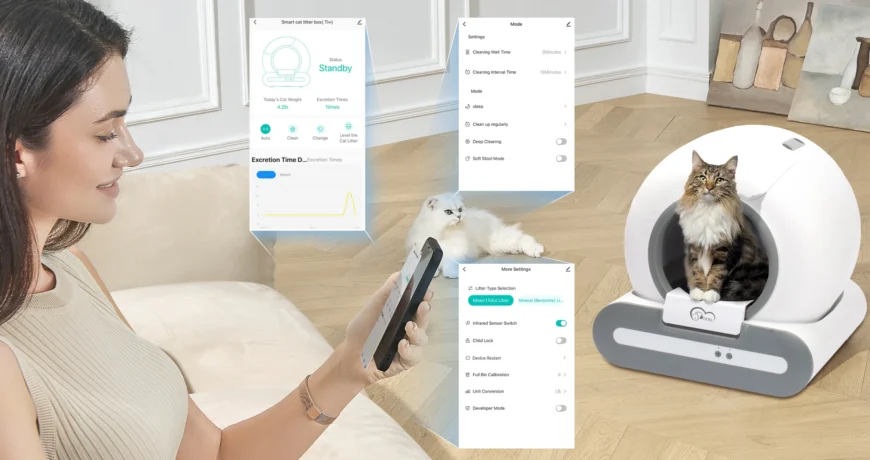
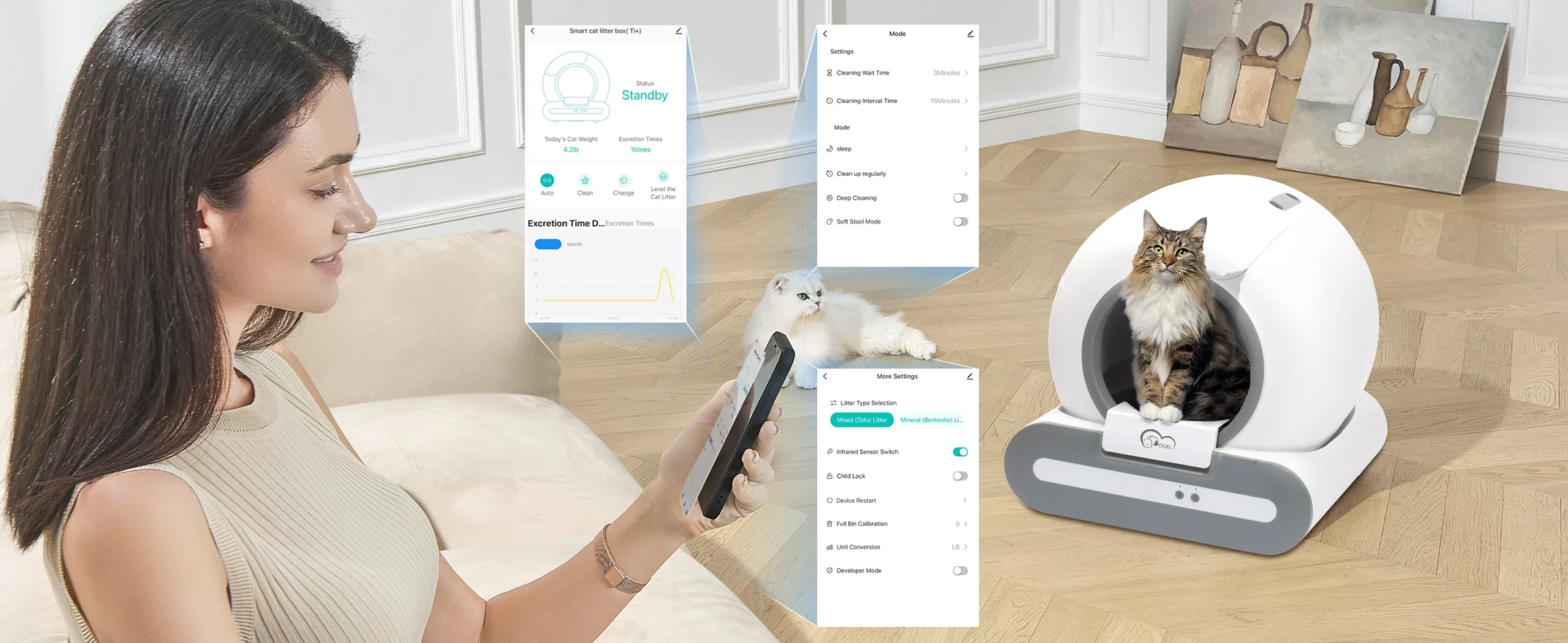
Every box has an app now, and most of them are forgettable. The two features that stay useful past the first fortnight are usage tracking and remote cycling.
Usage tracking matters because litter box habits are the earliest visible sign of feline urinary problems and kidney disease. A cat that goes from three visits a day to eight, or from three to one, is telling you something weeks before you would have noticed by eye. In a multi cat house the data is less precise, since the box cannot always tell one cat from another by weight alone, but a change in the household total is still worth a vet call.
Remote cycling matters for the boring reason that you occasionally want the box clean before you get home. Everything else, the scheduling, the notifications, the cute graphs, you will use twice.
Where the box goes matters more than people expect
Cats are specific about this. A litter box wants a quiet corner with a clear line of sight to the door, so your cat can see the room while using it. Do not put it in a cupboard, do not put it next to the washing machine on spin day, and do not put it beside the food and water.
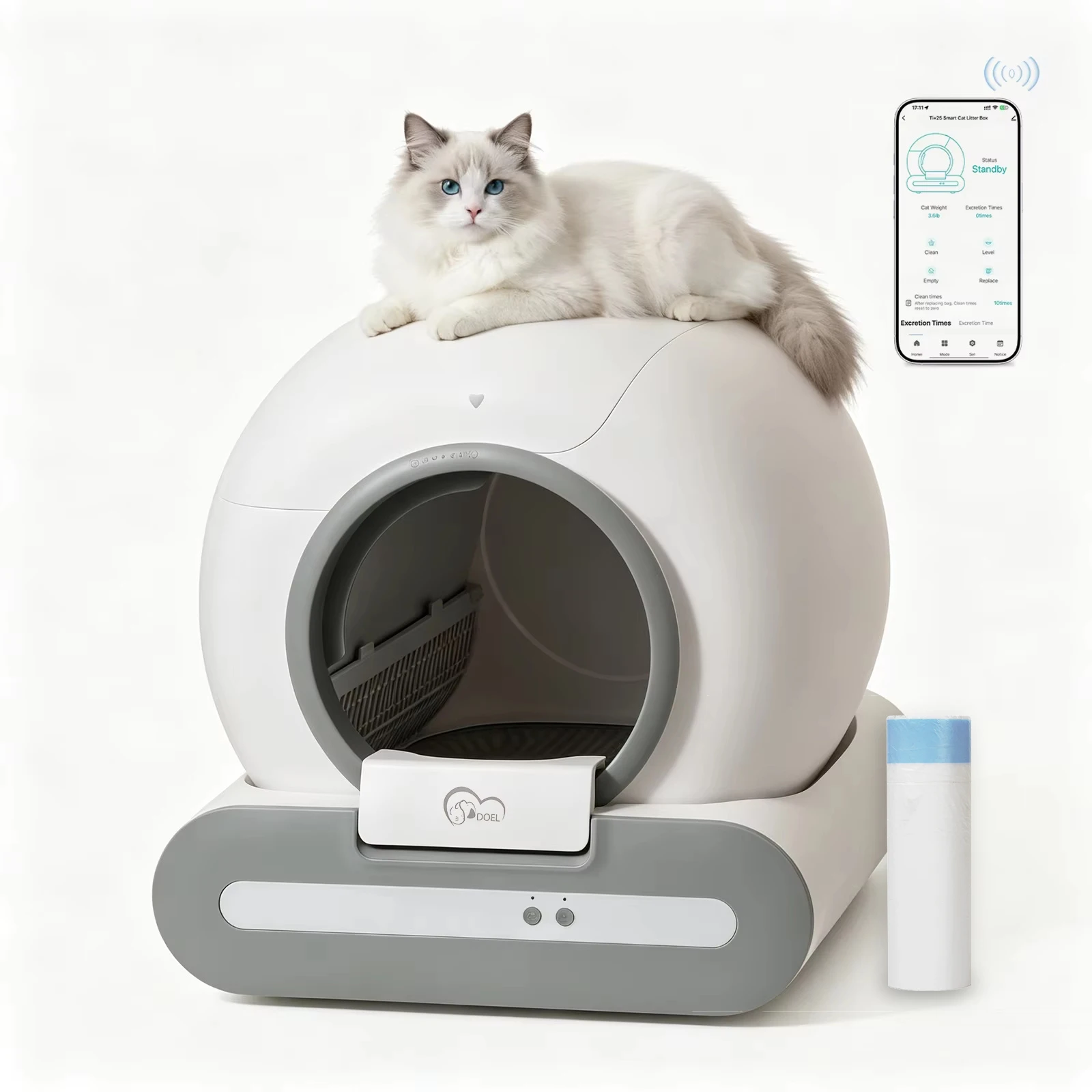
Give the box a wall and a socket, leave a foot of clear space in front of the opening, and put a mat underneath to catch tracked litter. If your cat is nervous about the motor, run the first week on manual mode and cycle it while your cat is in another room, so the noise never gets associated with being inside.
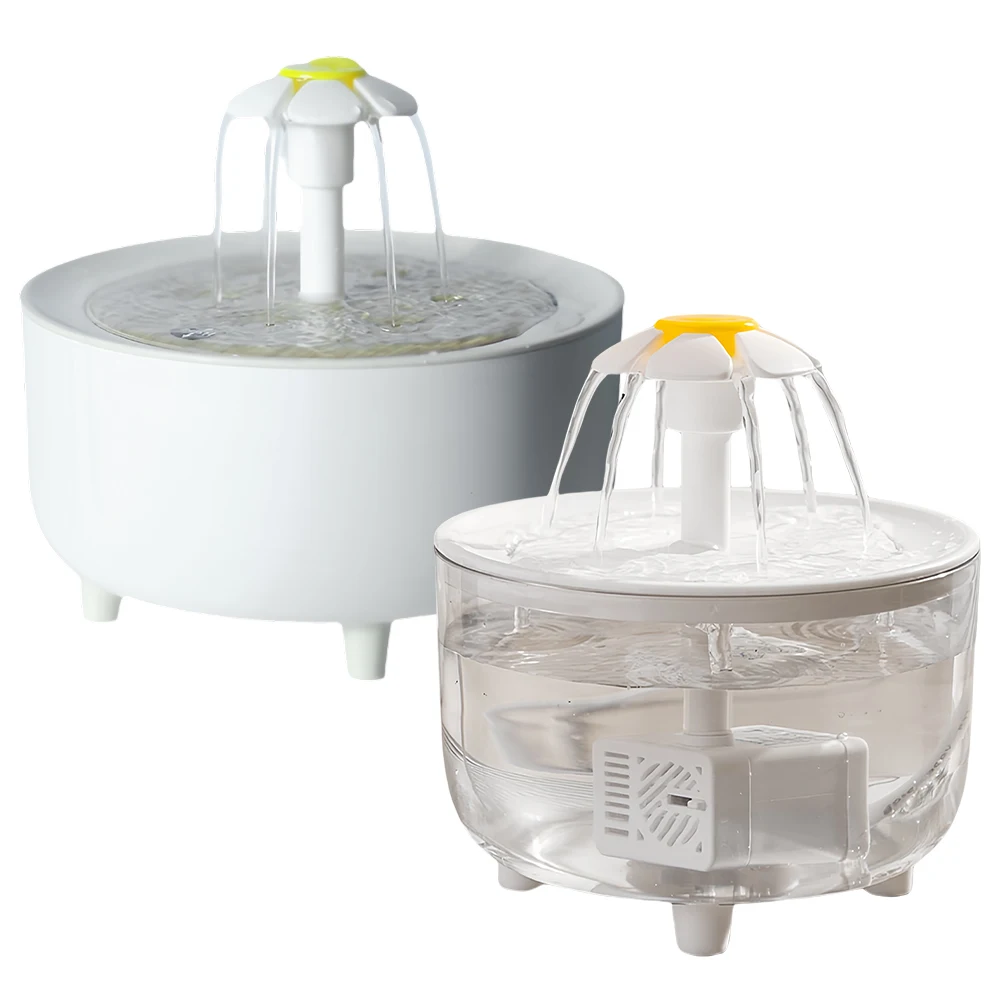
One more thing about the wider setup: cats want their resources spread out. Water in a different room from the food, a quiet water fountain away from the box, and somewhere high to retreat to. A cat tree with sisal posts or a wall stairway gives a nervous cat the vertical escape route that makes the rest of the room feel safe.
What a self cleaning box will not fix
It will not fix a cat that has stopped using the box. Sudden avoidance is a medical question first and a behaviour question second, and no machine solves it.
It will not fix an under provisioned house. The rule is still one box per cat plus one, and that rule does not change because one of the boxes is automatic. Two cats and one clever box is still one box short.
It will not fix smell on its own if the bin is left full or the drum is never wiped. The sealed bin buys you two weeks, not two months.
So is it worth the money
Honestly, it depends on who you are. If you scoop daily without resenting it, live with one cat, and have a box you are happy with, you do not need one.
It earns its money if any of these are true: you travel for a night or two at a time, you have a small home where smell is immediate, you have limited mobility or a bad back, you have more than one cat, or you keep meaning to scoop and keep not doing it. In those houses the box is not a gadget, it is the difference between a litter tray you manage and one you forget about.
If that sounds like your house, the 65L smart self cleaning litter box ships from our US warehouse. The rest of the cat range, from fountains to trees, is in cat accessories and the wider cat category.
Common questions
Do cats actually use them?
Most do, usually within a week. The trick is to introduce it switched off, filled with the litter your cat already uses, in the same spot as the old box. Let your cat use it cold for a few days, then turn the automation on. Cats that refuse are almost always reacting to a new litter or a new location, not to the machine.
How loud is it?
A cycle is roughly as loud as a fridge compressor and runs for under a minute. Most cats ignore it after the first few days. If yours is sound sensitive, put the box on a mat rather than bare tile, which takes the rattle out of it.
Can two cats share one automatic box?
They can, but they should not be the only box in the house. Keep to one box per cat plus one. The automatic box will happily handle the traffic; the problem is that cats guard resources, and a single box gives a bully something to guard.
How often do I really empty it?
About every two weeks for one cat with the 9 litre bin, weekly for two. Top the litter up when the bed drops below roughly three inches, and take the drum out for a proper wash every four to six weeks.
Is it safe for a kitten?
Not until six months. Kittens are below the weight the sensors are calibrated for, so keep them on a normal open tray and switch over once they are grown.
